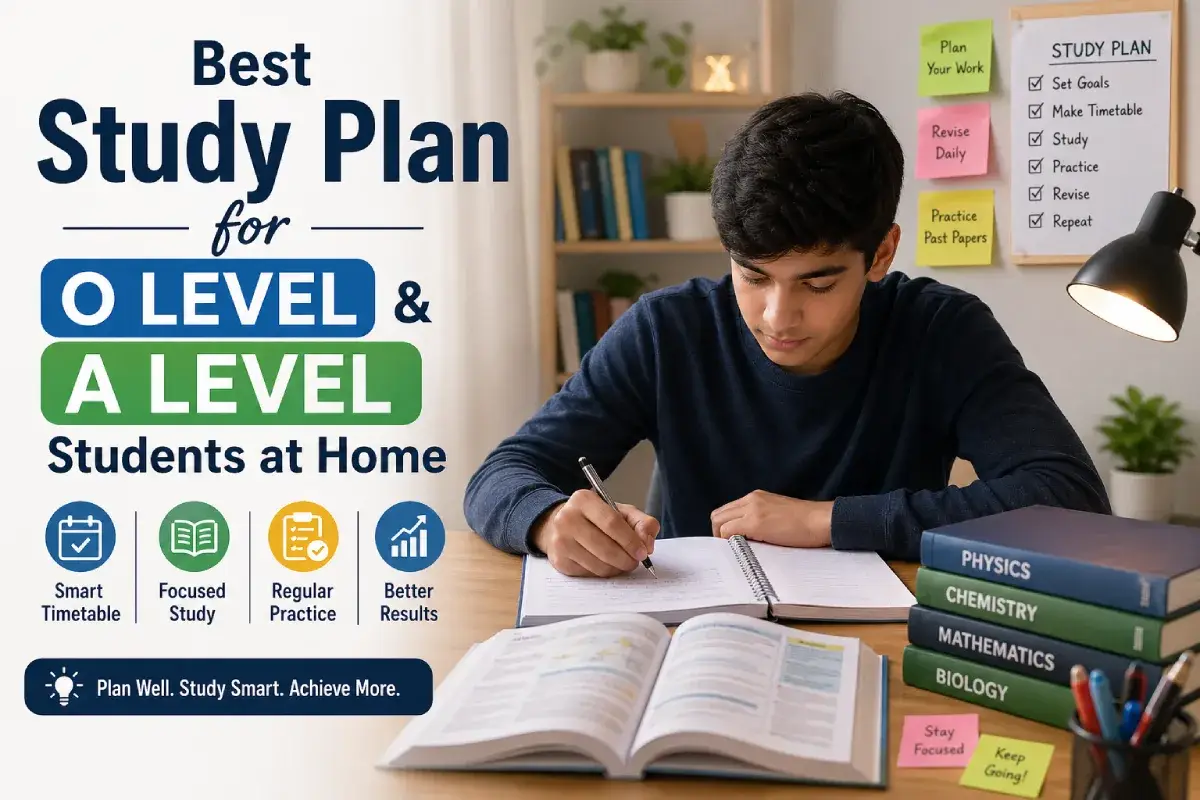
The first time you study for your O/A levels from home, with subjects regularly covering syllabus work from old exams, school work, exam pressure, and assignments, it may not work AT ALL. In fact, the problem is not that you may be weak, but that you study without a study plan.
A proper study plan keeps you oriented to what you need to study, when you need to study, and how you need to revise. It is much easier for your parents, too, as they can now see that their child is following a proper routine.
No matter what a student is preparing, AS Level, Cambridge O Level, IGCSE, AS, and A level, with the right study plan for home studies, they are bound to build a great deal of confidence.
Importance of a Study Plan for O/A Level Students
O/A level exams are going to be much more than memorizing notes. You must know how to understand various concepts, apply necessary problem-solving, and be able to work efficiently to complete all problems before the exam time is up.
For example, a student may know all the necessary O-level Math formulas, but they can still lose a lot of marks for not practicing past papers. An A-level student may know all the concepts of biology, but have a lot of trouble writing responses to questions that the examiners would expect.
The study plan has the following benefits:
- Ability to reach syllabus goals.
- Increased focus during revision.
- Improved familiarity with exam structure.
- Increased confidence during exam sitting.
- Ability to self-assess throughout the study plan.
- Spread out due dates.
- Enhanced plan compliance.
Poor planning leads to random study tasks.
Set a plan to better reach goals.
Step 1: Identify the Current Level of the Student
The study plan should have specific goals to reach and start with existing goals.
Ask the following:
- Skill Improvements.
- Areas of Specialization.
- Areas of Apathy.
- Tasks and Time Management.
- The Student’s Mastery Level.
- The Student’s Comprehension.
- The student’s mastery level.
A common example includes a student excelling in business studies and English, but lacking in physics or numerically based subjects.
A study plan should be tailored for the student. An unoriginal study plan is useless.
Step 2: Categorize Subjects by Level of Proficiency
After you assess your performance, break your subjects into three categories: Strong, average, and weak subjects.
Strong Subjects
These subjects show a strong foundation of knowledge and high scores with little effort. These subjects will require little additional time.
Average Subjects
These subjects require additional time and effort, but are less variable than strong subjects. The majority of students will have 2 or 3 subjects in this category.
Weak Subjects
These subjects, regrettably, cover the same domain of the student’s conceptual understanding. Students have difficulty both answering questions and demonstrating knowledge, and they struggle with self-efficacy. It is in these subjects that families will encounter situations requiring the most attention from a tutor, whether seeking O-Level tuition in Lahore or highly specialized services.
Step 3: Establish a Weekly Study Plan
A weekly study plan is preferred over a daily one, as daily plans tend to be rigid. Weekly plans provide students with a variable framework that alleviates them of time liability.
Here is a simplified study schedule:
- 2 days focusing on weak subjects
- 2 days for average subjects
- 1 day for strong subject revision
- 1 day for practicing past papers
- 1 day for light revision or a day off
Example:
Study Schedule:
Monday: Math
Tuesday: Physics
Wednesday: English + Business
Thursday: Chemistry
Friday: Biology
Saturday: Practice a past paper and mark it
Sunday: Easy revision + plan for next week
You shouldn’t study all day. Study with focus. If you study for 2 full hours learning specifics, you may learn more than someone who reads for 6 hours with full distractions.
Step 4: Use Short Study Sessions
Study blocks are short and most effective for O-level and A-level kids.
Try:
- 45 min study
- 10 min break
- 45 min study
- review
Use your breaks to get up and take a walk or get a drink. Don’t scroll through social media, or you may fall into a TikTok hole.
Step 5: Have Daily Study Goals
“Study Chemistry” is a vague, poorly defined goal.
You should outline some specific objectives in your plan, including:
- Finish the notes for your electrolysis section
- Answer 15 algebra questions
- Finish the review of a single chapter of Bio
- Do a practice English comprehension
- Complete a section from a past paper
- Learn the important definitions in your Business Studies class
Studies have shown that objectives of any type motivate students, especially when they can visualize progress.
Writing another blank studying section for Physics is vague, dull, and probably less likely to be carried out than the following example.
Write:
Revise forces and motion. Complete 10 questions on past papers from that section.
This example is clear and provides quantifiable goals.
Step 6: Learn how to make concise and clear notes
Learn how to take notes and revise more quickly.
Long notes are less productive.
Avoid writing out the page of the textbook. That will result in a subpar textbook.
Sensible notes use:
- Key definitions
- Important formulas
- Short explanations with supporting details
- Relevant Images
- Common errors
- Key points to answer the past papers
- Provide clear summaries of the lesson
Notes that are too lengthy are likely to confuse more. A good note should be straightforward and should clear the concepts.
Step 7: Do Past Papers Earlier
Many students are guilty of the misconception that past papers should only be tackled as exam time approaches. These past papers should be incorporated into the plan from the start.
Clarity on past papers is critical as:
- The styles of exam questions are illustrated
- Requirements of the marking as well as grading schemes are highlighted
- Indicative timings are shown
- knowledge and understanding of the syllabus are given
- Various aspects of the answers are structured
Consider A Level Economics as an example. Many students learn the theory but struggle to structure their answers. In O Level Chemistry, students have a poor understanding of reactions, and they typically lose a substantial number of marks due to insufficient detail.
Past papers allow students to think like exam candidates, not just as readers.
How to Assess and Effectively Analyze Past Papers
Using past papers as an effective and constructive tool is essential, as well as encouraging students to use them in the following manner:
- Revise the syllabus section.
- Answer the respective questions.
- Evaluate this against the marking scheme.
- Pinpoint the mistakes and comment on the poor submissions.
- Repeat questions.
Students require consolidation, which occurs through task redundancy and results in an enhancement of this particular technique on an individual basis.
Step 8. Reviewing Your Mistakes Weekly
Students should note down in a small notebook whenever they misstep and then evaluate the mistake to rectify and construct an answer. This is particularly because mistakes are not a sign of ignoring; rather, missteps should be noted, and when assignments are of concern, they consolidate knowledge and understanding.
- Questions lacking or omitted
- Topics lacking understanding
- Lack of knowledge of formulas
- Ignoring spelling or instruction
- Ignoring the marking scheme entirely.
As a result of the above, students should revise these points, for example, reinforcing Maths skills or phrasing answers in accordance with examiner expectations.
Step 9: Balancing School, Tuition, and Self-Study
This is something that many students would have been at school for, have gone for extra tuition, and still say, “I don’t have to revise at home.”
School teaches, and tuition supplements and provides additional tuition, while self-study crystallizes things.
A more balanced approach would consist of:
- School for knowledge
- Tuition for additional input
- Self-study for consolidation of knowledge, and practicing
- Past paperwork for weekend homework
Parents shouldn’t confine themselves to only, “Were you in class?” Rather, they should ask pragmatically, “Was class understood?” In combination, the two can unleash the timeless answer of many school pupils — “yes” — with an empty brain.
Step 10: Identifying the Need for Extra Support
Of course, additional support can take many forms, and it doesn’t always have to be an extra tutor. Also, the need for a parent/lawyer is to assist the student and work during their periods.
The need for additional support is evident if the student:
- Continues to receive poor scores and/or poor results
- Continues to resent the subject
- Continues to experience anxiety
- Struggles to apply
- Continues to experience low self-esteem
This is where a tutor in Lahore or an online tutor can assist with additional input to the student.
A tutor can target specific challenging concepts, provide solutions, and check understanding of the outputs. A tutor can plot and work to the boundaries of specific outputs that are at this point/formula in conjunction with a specific level at the exam board.
If you’re seeking professional assistance for your child’s O Level and A Level learning, WiselyTutors offers you the option of consulting one of their home-based and online tutors and structured exam prep specialists. You can book a free consultation and/or a demo session to help you decide on the most appropriate service plan.
Ways to Facilitate Learning O-Level and A-Level Students From Home
It isn’t a requirement for you to know the various subjects your child is learning to support them. What is essential, however, is to design the optimal atmosphere.
Here are some examples of how to best assist:
- Provide a peaceful, spacious place for them to complete their work.
- Ensure complete focus on the task at hand.
- Observe them and take note of how they learn.
- Let them take breaks and encourage them to get rest when they are tired.
- Resist the impulse to compare them to their peers.
- Compliment their hard work and do not focus solely on their achievements.
- Communicate frequently with their tutors or teachers.
Students are aware of the pressure they are under. Being critical only intensifies their anxiety. They need support, not fear.
Study Plans From Home for O-Level Exams
O-Level students need further assistance in learning the fundamentals. The years are of great importance for advanced learning.
Here are some important aspects of a good study plan for the O Level students and the subjects they need to learn:
- Daily Revision
- Students should revise what they have learned that day, whether from school or tuition. This should take less than 30 minutes.
- Concept Practice
- Students practice subjects such as Maths, Physics, Chemistry, and Accounting by applying theoretical concepts learned in class.
Writing vividly in English, Islamiyat, Pakistan Studies, and Business Studies is important.
Working with Past Papers
Students should work on organizing their subjects using past papers early on and later do full papers.
Weekly Assessment
Students should be given tests to examine whether the topics are being absorbed.
Those searching for O-Level tuition in Lahore should find tutors who help develop an understanding of the passage and prepare for exams.
Home Study Plan for A Levels
A-levels require extension. The study requires differentiated understanding, writing, and time management.
An excellent Home Study Plan for Advanced Levels includes:
Conceptual Understanding of Advanced Levels
Advanced-level students should prioritize understanding over rote learning and mechanics.
Working with Past Papers
For advanced levels, doing past papers helps to bridge understanding with the real world.
Reviewing Work
An understanding of an advanced-level response requires the command of language and clarity. Learning how examiners award marks is essential.
Study Plan That Cultivates Independence
Advanced-Level students should engage in studies that develop independence, as this will be useful in university.
Feedback
Students improve when they work with a tutor or a teacher to help examine their previous mistakes. This is a more effective way to correct errors.
Study Guide for the O-level and A-level Students
Here are a few guidelines students could follow while studying from home:
- Attempt your hardest subject while the mind is most active.
- Keep your phone out of your reach.
- Maintain daily goals and use a checklist to monitor your progress.
- Keep up with old topics every week.
- Attempt the previous year’s papers while following the schedule.
- A good night’s sleep is essential before a test.
- Instead of waiting for something, ask for help.
- Tough topics should not be put aside for the last month.
- You should review your mistakes and not ignore them.
- Progress may feel slow, but consistency is key.
It isn’t enough to study for exams; being consistent is what matters most.
Study Mistakes to Avoid
Many students study and still end up disappointed with their results, and for good reason.
- Try not just reading the notes; practice with the questions as well.
- Focus on those with a schedule.
- Try not to neglect your hard subjects.
- Do them with the help of papers designed in the past.
- Do not use them while studying.
- Learn from your mistakes.
- Take a good rest before the exams.
- Try not to focus on what others are doing; focus on yourself.
Don’t try to study perfectly; focus on your plan even on an off day.
How Tutoring Can Improve Home Study
There are many things a good tutor does, and one of them is teaching a student where they are weak.
Tutoring has many benefits for students, including:
- Simple explanations for challenging concepts
- Tailor-made study strategy
- Consistent study assignments
- Evaluation regarding homework and exam answers
- Assistance with exam responses
- Scaffolded promotion of self-assurance more
- Improved parent participation in appraising progress
At WiselyTutors, students can get help with home tutoring in Lahore, online tutoring, and exam-focused tutors for all O Level and A Level subjects.
This is a blessing for students who need continuous academic support and for busy parents who need dependable support for their children at home.
Conclusion
At home, O Level and A Level students’ study plans have to be simple, viable, and consistent. An impeccable routine isn’t what is needed. Rather, a plan, continual practice, and an honest evaluation are what are needed to provide temporary support to students.
An effectual plan is a combination of an explanation of the concept to be studied, study time, practice with exam questions, review at the start of the week, and intervals for recuperation. With a balanced routine, students can notably raise their scores and experience a positive increase in self-assurance just before the exams.
Parents need to be mindful that students learn at different paces. While some may benefit from fundamental time, others may benefit more from quality help, and simple explanations don’t belittle students.
WiselyTutors offers home tutoring and online exam prep for students pursuing O Level and A Level qualifications who need personalized learning support. If this is the case, book a consultation at no charge, and/or a demo session to help identify your child’s most preferred tutor and study plan.